The right kind of busywork in video games (May 2026)
If you're not getting VIDEO GAME ENTHUSIASM delivered to your inbox every month, what are you doing?
This month in BACKLOG YEAR, it’s back to basics; talking about some GAMES, some that are not old and I’ve gone back on BACKLOG YEAR and bought (save me from this pain) but a number that are. There’s a lot to be said for hardware chat, but eventually you have to sit down with that hardware and play some games, otherwise you’ve spend hundreds of currency units on nothing at all.
Here are games that we have been playing this month. There are some we loved so much that we’ve finished, or are still finishing, and some that we liked but not enough to get to the end. There is JANK. There is CHARM. There is PUNISHING DIFFICULTY. There is VIDEO GAME ENTHUSIASM.
As ever, you can write in to @makebad.games on Bluesky. OR: send an electronic mail to cor@fastmail.jp, our new address for sending the newsletter.
Prince of Persia: The Sands of Time review (Ubisoft Montreal, 2003, PC, Multiplatform)
Sands of Time, The is an action and puzzle-platforming video game, a reboot, with three-dimensional graphics, of the (unlockable in this) 1989 2D original Prince of Persia, and the first game in a quadrilogy. It’s the game that set the foundations for the smash hit Assassin’s Creed series; to the point that a planned sequel was instead spun off into the first game in that series.
The Assassin’s Creed games prior to the series’ shift to a role-playing formula play better than this in every possible way. However, this is the games enthusiasm newsletter, so I’ll say this; it’s colourful, the combat and platforming look flashy when you pull them off, and the music and the graphics keeps the energy of the whole thing up when you don’t. Mostly.
There are combat sections against multiple dozen enemies in tight spaces. The camera regularly glitches during these fights, and it’s too easy to get stun-locked; knocked down and be unable to recover before being hit again. When the game introduces bird enemies, there’s a lot of swinging wildly on platforms that they can and probably will knock you off. I rarely feel in control while fighting anything. There is a top-down landscape camera mode that is meant to make all the difference in combat, but that makes me wonder why all the fuss about the second attempt at bringing the series into 3D.
There are lengthy platforming chapters. These play nicer, and the swinging on bars and ropes and the wall-running and the wall-jumping are impressive to look at and intoxicating when you get them down pat under pressure. It’s too easy to throw yourself off a castle turret or stop dead in the middle of a wall-run. There are more instances where you’re fighting against the platforming controls than where they’re fluid. They’re sensitive, and not fun to use.
There should be more to the core mechanic of rewinding time other than it being there to mitigating the game’s built-in annoyances, but rewinds are finicky too. It’s easy to rewind time after being hit in combat and still take damage because the ten-second rewind has reset because you’ve used the dagger to dispatch an enemy, which you have to do to defeat them. Generously, this is the game requiring that you pick and choose when you strike enemies while they’re down, but having to be careful in combat like that, plus the requirement to double-tap enemies, drags out encounters that already throw too many enemies at you, and stop being fun and start being obstacles in the mid to late game.
I’d let the unrelenting combat sequences off more if they weren’t directly preceded by punishing, often timed obstacle courses, that if you’re not careful can leave you without health for the next section; at that point, why not reload and attempt obstacle course again, because the checkpoint system is forgiving in putting you back at the start of a combat sequence after death, but it won’t give you any more health than you started with. This will either be a welcome challenge or a pain to you; I find it irritating.
I go through phases of liking or not liking Sands of Time, depending on how much of a pain it’s being. I play it for hours and then I hit a point where I’m getting nowhere and need to put it down for the night. The game says I’m 80% of the way through. I glide through it. I get nowhere. I’m charmed by it. It’s of its time: impressive for what it inspired, but, when you could be playing any number of Assassin’s Creed games, it’s, at best, a proof-of-concept.
The bones of Assassin’s Creed are here. The counter-attack driven combat that’s great to look at, the graceful platforming animations that I’ll never tire of, the fantasy story mired in political intrigue. Assassin’s Creed’s modern day sections have never really done it for me, but then this has a they-probably-will-because-the-odious-prince-assumes-they-will romance (he’s deeply pathetic), so neither are masterclasses in storytelling. Regardless, I appreciate that Sands of Time is firmly in the fantasy genre versus Assassin’s Creed muddying the waters with occasional slides into science-fiction.
Assassin’s Creed 2 consumed my life when it came out. I did all the optional platforming challenges for the pieces of Assassin armor, and I spent ages picking fights with guards in the streets of Florence because it was fun. It was a game that I didn’t want to end. Sands of Time is a game that I’m relieved to get through sections of, to be a percentage count closer to the end. It’s felt like homework, a game that I’ve been playing because of its apparently unironic status as one of the best games of all time.
I wouldn’t say it lives up to that status now, although it may have been a good go at the time. Where it sits in the history of the constant balance between what a game tried to achieve and what it could at a technical level makes it an interesting game, but not one that you need to play.
The tone of Sands of Time, The is it’s best quality; the visuals are bright, the writing intermittently clever, and performances silly; the security guard with the voice of a Cockney market trader that narrates an early puzzle has to be intentionally funny. The Prince is sometimes childishly, entertainingly petty instead of the boyfriend that you settle for out of school, and the frame story of him telling the story (to the player? To other characters? I haven’t finished yet) remains novel now. If the strength of the game is in its lightness, the sequels going darker makes me unlikely to bother with them.
Sands of Time is a 3D interpretation of a strong concept that its slightly later contemporaries, like Assassin’s Creed, Infamous, and much later games like Ghost of Tsushima, properly realizes. What I appreciate the most about Sands of Time is its linear structure, and short length compared to the above. Unfortunately, despite that length, it overstays its welcome. It has enough small pleasures that I may finish it, but I’m ready to never think about it again.
Yeah, no, I remain stuck on this deeply irritating escort-combat section in a confined space and it’s going in the bin. The landscape camera helps keep track of [princess and extended escort mission] Farah to stop her getting her head kicked in, but it resets to the normal camera after a bit, and the whole thing becomes an exercise in perspective management.
Some notes for playing this on PC in current year. I used a plug-and-play fix compilation from Bluesky user Vinicius Medeiros (https://www.moddb.com/games/prince-of-persia-the-sands-of-time/downloads/sands-of-time-fix-compilation) to use a controller on the PC version, using a Legion Go running Bazzite. It works astonishingly well at 4K and the Legion Go’s native res of 2560 x 1600.
Let’s play something that’s the same but better.
Assassin’s Creed II (2) review (Ubisoft Montreal, 2009, PC, Multiplatform)
The aforementioned open-world Prince of Persia spin-off with additional modern-day conspiracy nonsense plot. This one is in Renaissance Italy. I rinsed this at the time and, d’you know what, it’s still brilliant. The platforming controls are loose, but not as loose as in Sands of Time; there’s room for error. but much less catapulting yourself off tall buildings. It’s more intuitive, which is to say, almost intuitive. Enough that I did all the optional tombs at the time, and on the latest save that I’ve spun off, I’ve free-climbed up and down a massive Florence church just because. Climbing feels satisfying and, not, unlike Sands of Time, anxiety-inducing. It’s terrific fun to be Italian Renaissance Spider-Man in this, and well worth the price of admission.
I love the counter attack-based combat. It’s fluid, manageable, and you’re not fighting the controls when you’re fighting. It’s fun to go around beating people up and slicing guards up the middle. Fair enough, you can’t vault over people like in Sands of Time, but there are dodges, and the hidden blade is so much fun to use in full-on combat.
I haven’t played the first game, so this one opening in-media-res is fine. Plot happens, and, although it is more interesting than the plot of Sands of Time, you are, much like in that game, riding the wave of the flashy and combat and traversal mechanics.
I’m doing what I do with most Ubisoft games which is play the side content more than the story. That’s not a slight on the story, it’s that there are times where my brain likes the busy work of climbing up towers to synchronies points, or collect codex pages that will give me health boosts that will be useful for the main content.
*I forgot to post it, but I did write a review once of Watch Dogs: Legion, where I got engrossed in the same thing; doing all the side-content before starting a single main mission. I should go back to that game, and that save. I think Watch Dogs is meant to be a dormant series now, which is annoying, because Legion is oodles of fun, and the permadeath mechanic breathes life into the dusty open-world formula.
Stop reviewing the wrong game!*
Before doing much else, I’m thinking I’ll level up Monteriggioni in full; I forgot all about this, because it’s not all that engaging and feels like it’s been pasted in from another game, but the main hub of the game is a small town that needs renovating, and renovations raise the value of the town, that goes into coffers that you need to empty regularly or they get full and you lose profit. It introduces constant management to a game that doesn’t feel as though it’s about that and for me introduces a sense of anxiety that I always need to be going back and checking on it. Renovations do serve a purpose; they provide a solid income to spend on weapons, armor, medicine and maps, and reduce the cost of purchases, so that said income goes further. It’s not pointless, and theoretically optional, but useful enough to engage with that I wish there wasn’t an arbitrary limit that I’m conscious of all the time.
And while we’re picking faults, I have a distinct memory that you need to collect and have Leonardo da Vinci translate (he’s such a cool polymath in this game) all of the Codex pages to unlock the final mission. The Codex pages are, up to that point, optional, though they do provide useful health bar boosts for every four you hand in. And I did do this at the time, and if I get to the end on this save I’ll likely do it again, but the busywork that I like in open-world games is the optional sort, that powers you up for the rest of the game IF YOU WANT THAT, not that becomes a requirement to continue. Saints Row 2 and the reboot has this, Ultimate Spider-Man (Treyarch, 2005, PC, multiplatform) has it. I would like games to not lock out content behind content. The PlayStation 5 made much of being able to select levels in Astro’s Playroom from the PS5 dashboard, and you never hear much about that feature anymore despite it being a brilliant idea. I haven’t played it much, but I love how Legend of Zelda, The: Breath of the Wild (Nintendo, 2017, Nintendo Switch, Wii U) lets you go straight to kick the big bad’s head in, if you want; Crackdown (Realtime Worlds, 2006, Microsoft Xbox 360) let you go straight for the gang leaders, even if wearing down their generals made your chance of success go up.
You can cheat a lot of the busywork out of the way on PC with trainers and saves, but I don’t think that’s enough to excuse game design that feels actively daunting, approaching a chore to engage with. What carries Assassin’s Creed II is that the traversal and the combat is as fun as it is, so I went along with it at the time and got all the codex pages. But, with the game, and games as a medium, being time-consuming enough, a player shouldn’t be forced to collect them. I’m a weirdo, but not everyone is. Not in this specific way, any road.
I used the plug-and-play EaglePatch (https://github.com/Sergeanur/EaglePatch/) to play the PC version of Assassin’s Creed II with a controller. Whether on Windows 10 or Bazzite, changing any .ini setting caused the game to crash at startup, but the good news is that the defaults work well.
Buck Up and Drive! review (Fábio Fontes, 2022, PC)
I got this in the BLOB UP AND SCOOP bundle on Steam, with BLOBUN and WORDSCOOP reviews to come later in this issue.
It’s a scrolling driving game like Sega’s OutRun, but you can ram other cars, and the police.
It’s a simple game with rock music that goes hard on a loop. I like how straightforward it is. It’s pick-up-and-play with the added depth of using fighting game-style combos (though relatively simplified; a hadouken at worst) for ramming cars, and a boost meter.
I wish there was an option to bind the ramming combos to single buttons; it would be a nice accessibility option and I would benefit from it. At the moment I mostly get by with charging up boosts and using those to ram vehicles, but more flexibility for more players would be ideal.
You drive, you hit boost pads, you hit other cars (including rivals sent to race against you) and they hit you. You’re sometimes driving fast enough that crashing into scenery or other cars feels unavoidable, but it’s so easy to get back to where you were. You grind on rails, you fly off ramps and do tricks for points, you crash through / into billboards; it’s as arcade-y as a game can be.
There are plenty of unlockables for replay value; each selectable stage in the game, when beaten, becomes available for a 1v1 multiplayer mode (CPU opponents and couch co-op available) akin to a fighting mode (I like it, but the arcade racing is what I come to the game for), and rival cars beaten in races become available for selection in the single-player mode that has taken up most of my fifteen hours and counting (twenty now, gosh) has gone into. There are a lot of stages, but I THINK you have to beat rivals to make more available for selection in a given run. There are themes to the stages that you’re expecting and then those that you’re not; it’s nice and surreal.
Buck Up and Drive! is one take on a formula, but it stands out from all of the other takes by being a personal, irreverent, political statement. Stitched into it is the notion that everything is political, even a silly video game about going nee-town (I meant nee-yown but I’m keeping it) in your little brum-brum car.
I got the game in a three-game bundle on sale for thirteen currency units. I would have happily paid that for Buck Up and Drive! alone. It’s a game that I can’t wait to play in my free time, and it’s dangerously close to becoming a game that’s going to directly impact the release of this newsletter, because I need to stop playing it, talk about it, and get it out of the way for a bit. I’m writing this paragraph while also breaking off to play it and woe betide me for not being in a body where I can play the game with one hand and write about it with the other.
I finished another run. That’s it for now. I promise. Although, what keeps happening is that my runs go well until the police chases step up to sending armored cars after me, and it’s super tricky to manage boosts and ramming combos to fight back and my fingers fall to pieces. That’s why I’d like to be able to map the combos to buttons.
Go play it, it’s so good!
It’s not the developer’s fault, but this crashes after two minutes in GameNative’s known config on the AYN Thor, and the controls break after a couple of minutes on my Proton 11 config, and I’m distraught by all of it, because it is that good that I want to play it anywhere and everywhere.
Capcom Sports Club review (Capcom, 1997, Arcade)
This is on your Capcom Home Arcade, plus where I played it: Capcom Arcade Stadium 2 on Steam.
Arcade-y, but still rooted in realism (there are no power-ups here) renditions of three sports; tennis, basketball, and soccer. These are simple to control (each game is controlled with three buttons and a stick), but the computer AI is either rock hard or I’m stupid. Despite this, I think each sport is a strong game-in-a-game, which is good, as to clear it you need to beat a tournament of each.
The graphics, music, and voice acting are cute. Other than ‘CUTE’, there is no underlying message, unless you count putting in CUM as your player initials a political statement, which I do.
I find it relentless. It’s HARD, BUT, the controls are intuitive, so it feels like me being bad at it is my fault. I feel responsible for how I do in the game, moreso when I start to button-mash out of panic; I should stop doing that.
I think my favorite is the tennis mode, which is up there with Virtua Tennis 3 and 4 for tennis games that I can sit and play for a whole night, but all of Capcom Sports Club is fun. I cleared it for the first time yesterday as I write this (with rewinds, because HARD or STUPID), and all the sports are well done, and easy to control, if not to win at.
It’s a great game to spend a few minutes on, or an hour. That’s what I’ve come to value most in games now; games with lengthy narratives to follow have their time and place, but sometimes you want to play a sports game that comes with no consequence other than it eating into your life because you’re playing it too much.
It’s a game full of joy. Modern emulation is great, because you can sand off of the frustration with rewind features. Sanding off frustration is good! Games should be fun, and a big part of that is that they should be as challenging as you can manage, as you want them to be.
The next game exemplifies this.
Blobun review (CyanSorcery, 2025, PC)
Another one from the bundle.
Fantastic, bulletproof even, ‘fill-all-the-squares’ puzzle game propelled by wholesome vibes and self-expression positivity. The second game in the bundle I bought with Buck Up and Drive! in it. It will probably run on anything, helped in part by it having both a Windows and a Linux build (although the user-forward LEVEL EDITOR is Windows only just now, according to the game’s. The graphics are simple; you might not have trouble running it through an Arm translation layer, in the absence of a native Android version. I’ll give it a go. Okay, I tried it on the AYN Thor with GameNative with the known config and the Proton version changed to 11, and it works well.
You are a lesbian who is turned into a slippy-slonky slime ‘blob bunny’, and there is a “”””””””lesbian toggle”””””””” in the settings with a consequence designed to wind up the right people. I haven’t finished Blobun yet, in part because it’s a puzzle game and I’m bad at them, but so far there’s been some plot at the start and then it’s been solid puzzles for four worlds.
The structure is strong; the levels introduce mechanics with easy puzzles first, and then they step up. I find the difficulty manageable, which is big for me as a person who struggles with logic puzzles. I might be stuck for a while on one, but I get there, and then there are strings of puzzles that I don’t have trouble with; it balances out.
I have four hours in this right now; when this issue goes online, I’ll have more in it. I tend to sit down with it intending to play for a few minutes and I go for an hour or more.
The game has staying power; you can make your own levels, and download levels that other people have made. My brain is not fit to devise puzzles, but that’s also fine! I trust other people to come up with interesting puzzles more than me.
I love the low-dexterity-ness of it. I don’t need to press lots of buttons at once, as it’s not about reactions. It’s directions, LB to restart puzzles, and optionally the A button to move faster (which I never use). Oh, and, in terms of sanding off frustration, B to revert your last move. The designer of Blobun does not want you to be frustrated; you can even skip puzzles to come back to later, or punt them out of your life. It’s described on Steam as a ‘casual puzzle game’, and I love that. It’s novel. For all my ‘I’m a dimbo’ bits, I like puzzle games and play a lot of them; Blobun is the puzzle game in my rotation that requires the least dexterity, and that isn’t designed to drive you insane with how difficult it is.
Blobun is so frictionless that it feels odd for Dr. Margaret Downs, PhD. to not be reviewing it for the cozy corner, but she has other things for this issue. Here’s one of them now.
Margaret Downs’ Loddlenaut review (Moon Lagoon, 2023, PC)
I described Loddlenaut to my best friend this way: “You’re a little guy doing ocean cleanup and helping restore the ecosystem.” That’s fundamentally what it is, and it doesn’t need to be a whole lot more than that. An evil-sounding corporation has left a big mess in their wake, and you’re the one tasked with cleaning it up and allowing the plants and Loddles (very cute little aquatic creatures) to thrive again. This was a rare PC game for which I ended up pulling out an old Xbox controller and actually figuring out where all the buttons are and starting to commit it to memory. I’m usually a keyboard-and-mouse person, but there are enough different actions that require different buttons that I found the controller to be useful.
As the game progresses, you come across different kinds of mess that require upgraded gear to clean, and either Chief Raccoon and I are both really bad at taking directions or it’s not all that clear how you get the materials for those upgrades. (It really could go either way, as our former-pleasure-to-have-in-class synapses are pretty fried. In hindsight, it’s fairly obvious even if it isn’t explicitly explained.) Once you do figure out the upgrades and manage to set up outposts in other areas besides your home base, the resource management goes extremely smoothly and satisfyingly. This isn’t to say it’s unsatisfying beforehand, but it felt a little clunkier and I was less inclined to spend hours on end in the game. There’s enough exploration to keep things interesting, but not so much as to be overwhelming, and the same goes for the plot. It’s there, and interesting, but not super deep. I think the relative simplicity of Loddlenaut actually ends up giving it more replay value than if there were a huge plot twist.
I’m finding that Loddlenaut and Spiritfarer (which I am on record as enjoying) are similar-feeling games. Both deal with fairly bleak subject matter, but are cozy resource management games at their core. That’s a sweet spot for me, strangely, as the world continues to be a garbage fire around me. In Loddlenaut, you’re more on your own than you are in Spiritfarer, which works for me right now but may not have five years ago. This is all to say that I can’t fix the world, but I can help some cute little digital fish have a cleaner home.
WordScoop! With Gelato the Otter review (WhiskerFjords, 2025, PC)
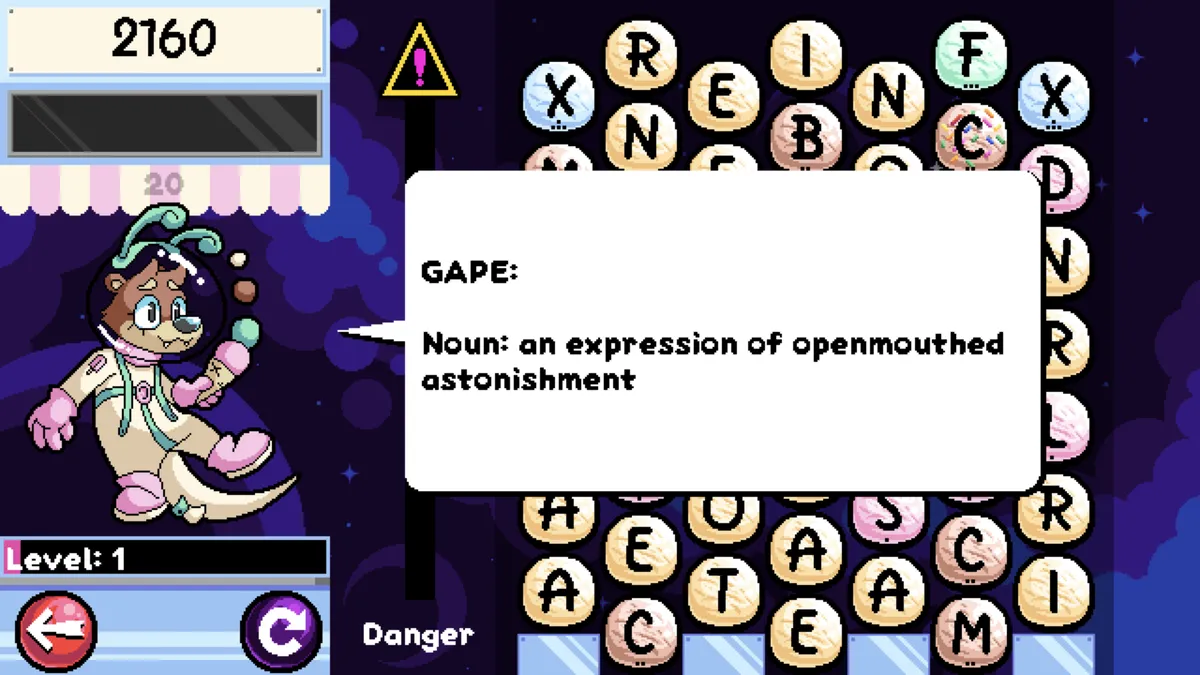
The final bundle game.
A spiritual successor to Bookworm, the ‘make words from letters in a beehive grid’ game that I’ve discussed on here before in becoming fond of the DS version. You have the mascot and the more-ish single looping music track, and so you might think that there’s no reason for it to exist. I disagree; you can’t get Bookworm Deluxe on Steam anymore, and even if you could, it doesn’t run on an Arm translation layer, throwing up an exception error, which is so disappointing because this sort of thing is the perfect portable game.
There is an Android build of Wordscoop, but it’s in testing, and exclusive on Itch; this is the last game in the bundle of three that I bought on Steam, so I don’t have access to it. WordScoop worked just fine in GameNative, mind you, although I think I’d like the native Android version for power efficiency. There’s also a native Linux version, which is delightful.
WordScoop does make improvements to the Bookworm formula; definitions of words are no longer blink-and-you’ll-miss, as there’s always a button on screen to display the definition of the last word that you’ve played. There are more modes than Bookworm; it has a version of Bookworm’s Action mode, where burning tiles (themed as ‘voids’ here) spawn repeatedly as you play, and a mode with a ten minute timer, plus an un-scored ‘chill’ mode with no fail state. You can also reduce motion effects for any reason you like.
It has a fatal flaw compared to the Bookworm games, in that you can’t save your progress in a game and come back to it later; that’s something that I feel it needs for it to be something that I daily drive (I have over 100 hours in Bookworm Deluxe on Steam, and increasingly play the DS version mentioned earlier).
Other tweaks include a dictionary where you can check if a word is playable, and read its definition. I haven’t had much use for this, mind you, but it’s an additional feature. The dictionary lets you play place names, which is fine. It feels out of step with traditional word game rules, but fair enough.
I love the ICE CREAM and otter in space theme. It’s the developers going ‘how do we do Bookworm again’ (complimentary), and even though there won’t be a better name-mascot combo for a word game than ‘Bookworm’, it’s all cute.
WordScoop doesn’t bring Bookworm up to code, but it’s a legally available take on it that, despite its simplicity of presentation (there’s nothing like in Bookworm where you’ll play burning tiles and the little worm guy burps) comes with enough charm.
Accessibility corner: Emulating games with funky control schemes
Confidential Mission review (Sega, 2000-1, Dreamcast, Arcade)
A lightgun shooter from Sega (House of the Dead, Virtua Cop, etcetera) that’s been forgotten in favor of those other lightgun shooters. I’m not sure why; the voice acting and the translation is just as ropey (complimentary) as in House of the Dead, so the awareness that you’re playing something that’s daft fun is still there. It’s Virtua Cop that I haven’t played; Confidential Mission is the one I saw and played in arcades growing up; it might seem more original to me as a result.
You, and potentially a second player, are secret agents sent to investigate the hijacking of a satellite. It’s very Brosnan-Bond in its outlandish depiction of supervillains and their geopolitical desires, plus damsels in distress. It’s comedic, but self-aware in that.
The game is stupid fun, but the reason I’ve brought it in today is to say that I’m emulating the Dreamcast version (in the standalone version of the Flycast emulator) on the AYN Thor using the touchscreen of top screen as a lightgun. For dexterity, this is wonderful; I can play it with one finger, or maybe two, so that I can have one finger on the edge of the screen (or a physical B button so that I can still play it in widescreen) for quick reloads. I had no luck mapping a controller and the Android touchscreen to the same port in Retroarch, but it works a treat in the standalone version of Flycast, and the settings menu is intuitive, so it’s easy to get going, which I can’t say for Retroarch.
This has breathed new, portable life into a game that’s hard to play well without aging cathode-ray-tube (CRT) televisions; I don’t own one, and modern LCDs don’t supporting traditional lightguns. I mentioned last issue that connecting a Mayflash Dolphinbar to use a Wiimote as a mouse to then emulate as a lightgun is a solid budget option, while the Sinden Lightgun a considerable step up from that in both tech and price, but making lightgun games use the Android touchscreen is an alternative that’s even easier to set-up and, from my perspective as a person with hemiplegia, more accessible than holding and pumping the massive-looking Sinden. It’s so easy. You just point. It’s accurate, but the pace of the game, the amount of enemies on the screen, and the timed mini-games putting you under pressure means that Confidential Mission, for example, remains challenging when played in this way.
Turning it into a one or two-finger touch game makes it low-dexterity, which means that I can play it on the bus without much faff. I think that’s why I’ve fallen for this novel control method. Even with my condition, I don’t think touch controls are a robust accessibility solution; it helps to have tactile buttons, and that’s why I always carry the 8BitDo Lite SE in a bag with my Thor. But with lightgun games, the buttons aren’t important. They’re for menus. Or, yes, you want a physical button for reloads and the occasional time-pressure challenge that needs a physical button. Reducing these games down to predominantly touch controls works well.
WarioWare Twisted review (Intelligent Systems, 2004, Nintendo Game Boy Advance)
Microgame collection sequel with a tilt sensor in the cartridge and without a European release. Playable today in the My Boy! Emulator on Android.
Mostly engaging and rarely annoying, you turn the device like a steering wheel to control the games (apart from select ones that use the A button and don’t support tilting; none of the games require the d-pad that I’ve seen, and per the manual). There are some that seem to involve tilting the device a LOT, so it’s not always an accessible video game and some of the microgames (one boss stage that has you walking up a spiral staircase with crumbling steps took a while to get down), but the advantage to emulating is that you can put the physical buttons as a virtual overlay, so you only really have to hold the device to play, which makes it manageable. Your arms might ache.
The novel control scheme means that I’ll never be as capable at it as I am the GBA original, or the GameCube reworking of that game. BUT, it’s a bold move, one that I’m looking forward to showing it to Margaret, and all of the games are brand-new.
It’s impressive that a game from twenty-two years ago has gyro controls this effective (it worked initially by having a nifty tilt sensor in the cartridge); the bottleneck is me and my ability to TWIST the device I’m using past a certain point without discomfort. The nature of the game means that it’s not all that suited to a dual-screen device unless you want to do the hinge in.
I’m going to play it some more and see how far I get before the game exceeds my dexterity.
Star Wars Episode 1: Racer review (LucasArts, 1999, Sega Dreamcast, multiplatform)
I’m something new with the title formatting; listing the system that I played it on first, and then not listing every system it came out on, which for this would be silly, because it came out on a lot of things a lot of times, including a recent re-release on modern systems.
This is a film tie-in game for a franchise that I have no abiding interest beyond the bit in the Phantom Menace where the lad has to race to escape the clutches of his enslaver. It’s a game based on that bit, however, so here I am. I also played this in anticipation of the new take on pod-racing, STAR WARS GALACTIC RACER (October 2026, PC, multiplatform).
I have misjudged this game. I spent the first couple of hours holding A to win the game’s first tournament, and then when the next tournament started getting tricky with its tight turns and optional shortcuts and large jumps, I started to think that the game couldn’t be that simple, because it was starting to kick my teeth in.
Reader, it is not a simple game. For a film tie-in, it has surprising depth. There is a tricky boost mechanic; there is a button to make your pod slide through turns; there has been enough thought put into how the pods handle that holding A to win isn’t always a viable strategy; the different racers’ (of which there are many to unlock) pods each control differently, so the character you choose should be the one that suits your play-style. Episode 1 Racer is not a game to be taken lightly, and I recommend that, because you’ll have more fun then. The additional depth of pit droids and sliding and turning the pod on its left or right side, the taunting of other players, the various camera angles, aren’t required to do well until a couple of races into the second tournament, but you should familiarize yourself with them first to avoid a bizarre uptick in difficulty.
For full disclosure, I am emulating this, a game from an era where games came in a box, often with a manual. I did not pull up the manual until the game started getting difficult, which meant that I had spent about two hours not understanding the game at all. That works out for the first tournament, but then you do have to apply yourself. Even having grown up buying games and then poring over the manuals on the way home, it completely passed me by to do it for this. Games of the time expected you to read the manual; Episode 1 Racer has no tutorial. It does not hand-hold you. It expects you to arrive to it with knowledge of the game’s mechanics.
I should have known to check the manual first, although I never played this at the time. The only Phantom Menace game I had was the actual Phantom Menace game on the Sony PlayStation. But, I wanted a racing game that was less realistic, and I wanted to gauge my interest for the new one; I’ve seen the trailer for it and it looks okay.
I was dead bored with this for the first couple of hours; the tracks were simple, any environmental obstacles were easily avoided, or easy to recover from, and I finished every race in the first tournament in first place. The gameplay isn’t primitive; it plays well for a racing game from 1999, and holds up to scrutiny. The issue is that, that, for a while, not much happens.
But then you reach a point where your persistence with a drab opening tournament comes good. There’s a damage system for your pod’s modules, and you can purchase pit droid upgrades to repair those parts on the fly. I didn’t put prize money into this, as crashing and respawning repairs the parts, and I wasn’t crashing all that much anyway, so I thought it was superfluous. What a clump, then, because now I’m hurtling through tracks with tight turns and massive vertical drops that are blowing me to pieces and teaching me that damage does persist across races, and you are supposed to be replacing parts every now and then.
The strafing is less accurate than I want; it’s like pinging from side to side, which is bad in a game with a vehicle damage system, but the sliding is there. The manual points out that the analog controls are sensitive, which is fair enough.
When the game kicks off properly and you know what all the buttons do, Star Wars Episode 1: Racer is an engaging challenge. The lack of initial challenge brings it down, but it’s a tie-in video game for a film, so I understand the compromise; you want it to be accessible early on.
Given that my initial goal was to see how excited the old one 1 could make me for the new one, it’s been a worthwhile exercise; I am now curious about Galactic Racer to see if it builds on the promise of Episode 1: Racer, hopefully without the whiplashing difficulty spike; job done. A modern take with better analog steering and the same smattering of depth could do well.
I understand Episode 1: Racer now. I urge you to give it time to settle into its groove. And for gosh sake; read the manual.
I’m still waiting to do a Nekomancer of Nowhere review (Standing Cat, 2025, PC) while it gets controller support like they said it would at PAX East but in the meantime here are Margaret’s impressions of it
Chief Raccoon and I saw Nekomancer of Nowhere demoed at PAX East this year. Controller support isn’t as necessary to me as it is to CR, and I was charmed by what I saw at PAX, so I grabbed it. (Sidenote, even though I don’t NEED a controller, I hope the developers make it available soon as it’ll broaden the audience for the game and I might take advantage of it myself.)
It’s a solid addition to the list of games that support the thesis of “there should be more games where you’re a cat.” You play as a “nekomancer”, a portmanteau of the Japanese word for cat and “necromancer,” advancing through a spooky old mansion by resurrecting ghosts as a cat who communicates only in emoticons. Each level (at the time of writing, I’ve played four) is a series of puzzles that you advance through by popping between realms and resurrecting the ghosts you find there. It’s got Portal vibes to it, but it’s not as involved and even my worked-late-collapsed-in-my-PJs self can handle it. My spatial reasoning is truly garbage, and I don’t always get the rhythm needed to resurrect the ghosts just right, so some of the puzzles take me longer than they’re probably meant to, but even then I don’t find it overly frustrating. Crucially, I don't think it's possible to lock yourself out of any part of the puzzles.
You get to interact with the ghosts you’ve resurrected at the end of each level, and they range from being weirded out to grateful. You also meet some of the inhabitants of the tower, and there’s a suggestion of a full-on backstory for some of them, but I kind of like that it’s left up to interpretation, at least at the start. All in all, I'm very eager to get further into it.
Games that I am playing that I’ve already reviewed or am not ready to review yet and may or may not in the future
*I’m trying something new again; I’ve been caught in a loop of playing some old favorites that are now comfort games, and I’ve been playing things that I’ve yet to get a feel for yet; decide for yourself which is which, and consider it an honorable mentions section.
Wii Sports (Nintendo, Nintendo Wii)
SoulCalibur (Sega, 1998, Sega Dreamcast)
Beyond Words (MindFuel Games, 2026, PC)
Word Play (Game Maker’s Toolkit, 2025, PC)
Theme Hospital (Bullfrog Productions, 1997, DOS, PC, Sony PlayStation)
Thank you for reading this month’s Capitalist Overlord Raccoons!!
On the face of it, this has been a themeless month, but ahhhh, it’s been a SIT DOWN AND PLAY GAMES month, and a games that have beguiling difficulty spikes month, and a games that actively morph into being chores despite actually being great underneath month, and a games that have novel control schemes month.
I’ve enjoyed just sitting down and playing things. It’s been distracting and peaceful, even when the games have decided to get rock hard for no reason. Not every issue can be, or needs to be, a barnstorming event special. The honorable mention or ‘playing now but no strong opinion yet or ever’ section is helping me understand that not every game needs to be included in long-form; I should be ENTHUSED to include a game.
It’s been great to get back on my Sega Dreamcast obsession, a month after going to PAX East and buying the t-shirt from the Limited Run Games stall. Episode I Racer isn’t a Dreamcast exclusive; it’s not even a console exclusive, but the PC version, being 27 years old, isn’t fit for purpose, and even the GOG release needs an additional patch for controllers. So emulation it is.
BACKLOG YEAR continues apace, spiraling down a shaky road up a mountain. Even though I haven’t been altogether successful in not buying new games, I am being careful about what I buy: buying interesting Indies, and saving myself for the BIG PUBLISHER games that I’m cursed to want to play (the Forza Horizon 6 Steam page is very much in the room right now).
See you next month!
(there were arcade and Sony PlayStation 2 exclusive sequels, BUT)↩